

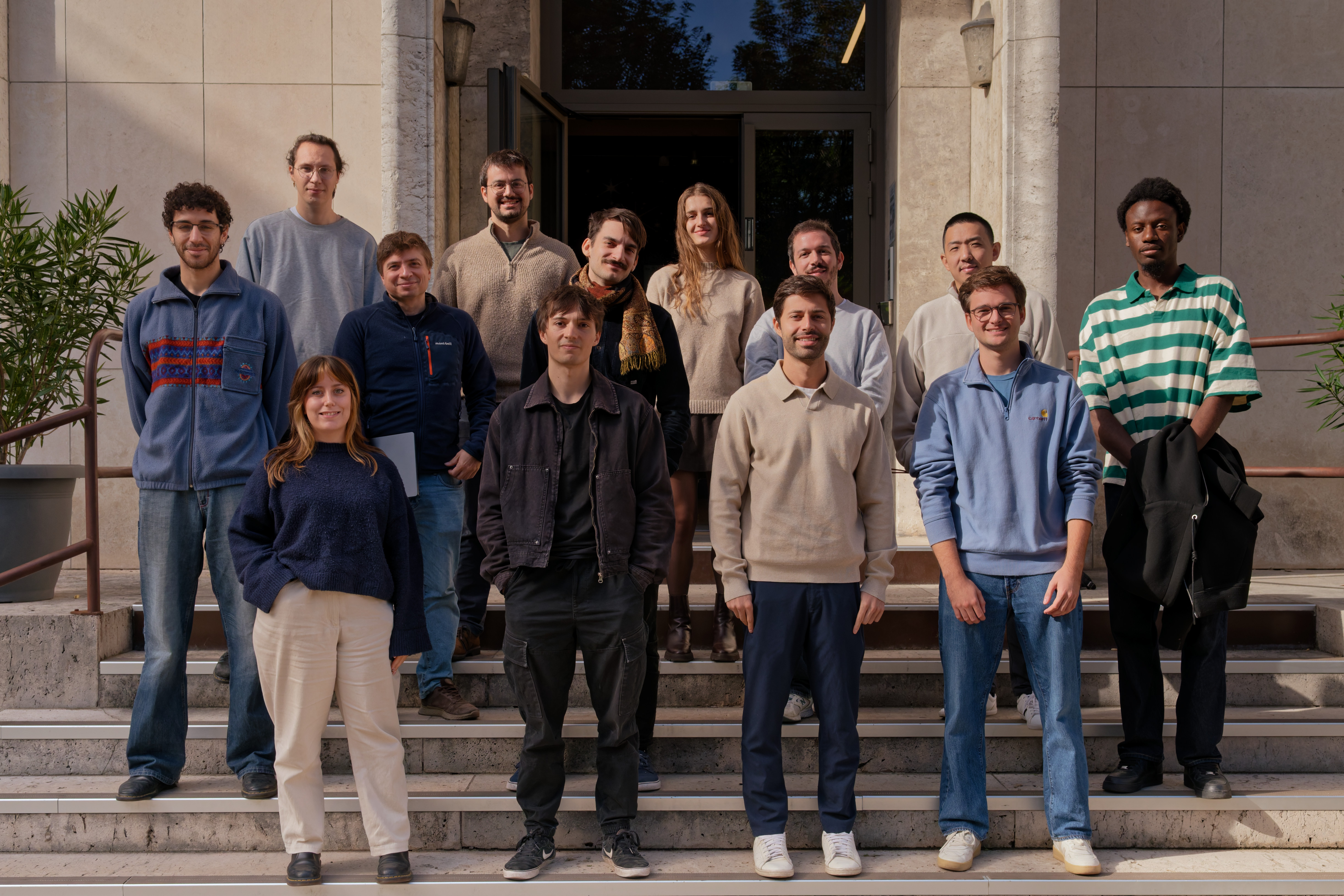
Photo: J. Mouette (IAP-CNRS-SU)
WELCOME TO THE CLASS OF 2026!
The new class of PhD students, postdoctoral researchers, engineers, an apprentice and an assistant astronomer joined the IAP in the fall of 2026.
At the welcome meeting held on 12 October 2026, the new arrivals were introduced to the institute’s organisation, along with essential information they might need and the key contacts they may interact with during their time at the laboratory.
The research topics these early-career researchers, engineers, the apprentice and the assistant astronomer will be working on are highly diverse, reflecting a wide range of funding sources: government-funded scholarships (including specific contracts from the École Normale Supérieure), scholarships from the Centre National d'Etudes Spatiales (CNES), and grants from the Agence Nationale de la Recherche (ANR).
All IAP staff wish them a fruitful stay, rich in scientific and technical exchanges.
The laboratory also congratulates the new doctors, who recently left the Institute at the end of their PhD.
| Susan Alexandian | “The Role of Resonances in the Long-Term Relaxation of Self-Gravitating Systems” |
| Maxime Assuerus | “A Comprehensive Search for Black Holes in Globular Clusters” |
| Clémentine Conegero | “Cosmological Implications of Nucleated Phase Transitions” |
| Marceau Decreux-Duchene | “Multi-Messenger Study of Galactic Binary Pulsars with LISA and Next-Generation Radio Telescopes” |
| Chams Gharib Ali Barura | “Primordial Cosmology in the Era of Gravitational Waves” |
| Mara-Andreea Iancu | “Spirals Matter: The emergence of Galactic Morphology and Scaling Laws” |
| Noah Jamsin | “Multi-messenger study of kilonovae” |
| Vincent Lefloch | “Probing Quasar Environments Using Proximate Molecular Absorbers” |
| Matthias Teboul | “Demographic Study of Cold Exoplanets Combining Euclid and Roman Space Telescope Data” |
| Rafael Arango | “Reading the Past of Disk Galaxies: Observations vs. Simulations” |
| Emanuele Fondi | “From Primordial Non-Gaussianity to Galaxy Clustering: A Field-Level Approach” |
| Martin Fournier | “Study of Galaxy Cluster Simulations and AGN Feedback, Complemented by JWST Observations” |
| Kiyam Lin | “Simulation-based inference with large galaxy clustering simulations.” |
| Simone Rossoni | “High-Energy Astrophysics and the Early Universe: The GRAND and HERON Projects” |
| Samuel Sanchez Lopez | “Testing flavors of the early universe beyond vanilla models with cosmological observations” |
| David Trestini | “Unravelling the source of gravitational waves: at the crossroads of post-Newtonian theory and self-force” |
| Georgia Stewart | “Exoplanet Characterisation with the Ariel Mission” |
| Jade Maisonneuve | “Development and Maintenance of the ELViS Instrument Simulator and Image Processing for the VIS Instrument” |
| Soizic Malleus | “Administration of IAP Clusters” |
| Marvin Abdou | “Migrating an Active Directory Without Downtime” |
| Maximilien Franco | “Eclipse - Euclid Calibration of Luminous galaxies In the Primeval universe: Selection and Environments” |
Layout: Jean Mouette
October 2026